 Vantage
The way we frame something shapes how we navigate it.
Geopolitical risk has become a checklist item for any forward-looking business. Diversify the supply chain, hedge the exposure, hire an expert to produce scenarios. This is prudent, but a frame that only asks “what could go wrong?” has a serious side effect. It stops asking anything else, limits our imagination and overlooks new markets.
“The way we frame something shapes how we navigate it.”
In one dominant version of academic framing, the macro trend driving much of this is the “reorientation” of the global order. Post-Cold War unipolarity is waning, giving way to multipolarity, or more expansively, multiplexity - a system characterized by overlapping networks, multiple actors, and diverse forms of authority, rather than merely competing poles of power. While there is no shortage of terms to describe this shift, the fine print is crucial. Global coordination is fragmenting, established norms are decaying, and new ones are emerging, including the growing protectionism and weaponization of critical supply chains.
For business, this might not just be a rough patch. It is becoming the new operating environment.
Meanwhile, a range of global challenges are becoming more complex and increasingly entangled with this geopolitical reorientation. Artificial intelligence and synthetic biology are advancing faster than we can govern them. Climate targets once seen as attainable (1.5°C) have practically slipped away. Outer space, the deep seabed and the polar regions - quintessential global commons - are increasingly sites of commercial and military contestation. And implementing global pandemic cooperation remains difficult even after the most consequential pandemic in a century.
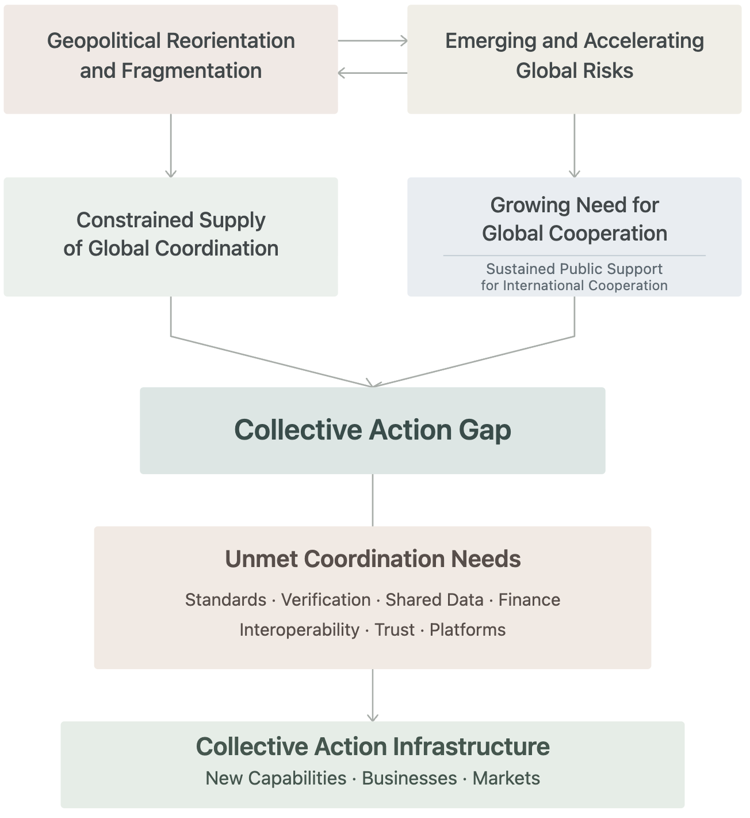
These challenges differ, but they share a defining characteristic: they are collective-action problems that no country can adequately address alone. This leaves us with a paradox. As the need for global coordination grows, its traditional supply is increasingly constrained.
The conventional view holds that trust in global institutions is collapsing and nationalist sentiments are hardening against cosmopolitanism. The evidence is more nuanced. A 2026 global survey by Ipsos found 65 per cent of respondents supporting the authority of international bodies to enforce solutions to problems such as environmental pollution, up from 59 per cent, with increases across generations, income groups and nearly all countries. Additionally, 40 per cent considered themselves more citizens of the world than of the country in which they lived, up from 33 per cent. A 2026 UN Foundation survey found 84 per cent calling the UN necessary, while 52 per cent felt it was struggling to deliver.
“In business terms, people seem dissatisfied with the supplier, not with the product.”
For those of us in governance, that gap is an institutional problem. For businesses, it raises another question: which of these unmet needs can become markets?
What Does This Look Like?
During my years at the United Nations, I saw this pattern more than once. In negotiations on the global disaster risk framework (the Sendai Framework), governments were cautious about the scope of risks to include. Finance, insurance and manufacturing - the sectors that price and absorb many of the losses - pressed for a wider scope.
“Risk, it turns out, is defined more generously by those who pay for it.”
A similar dynamic appeared during the SDG negotiations. Governments initially struggled to agree on closing the gender pay gap, while many large transnational corporations had already initiated internal policies. This is not to suggest business was inherently more proactive, but that formal political consensus was not always a prerequisite for action.
Treading Carefully
This is not a case for business rescuing global governance or replacing public institutions. While some industry groups have advocated broader risk coverage and collective action, others have resisted stronger environmental and social regulations. The private sector can be a constructive partner and, at other times, a loud holdout. Both can be true in the same room in the same year.
“Political legitimacy cannot be outsourced, and private power creates collective-action problems of its own.”
The Business of Coordination
The opportunity, then, lies in what we might call collective-action infrastructure: the rarely visible layer of standards, measurement, verification, shared data, financing and trusted platforms that makes cooperation possible.
When commitments cannot be enforced, someone needs to verify them. When information is fragmented, someone must make it legible. When public finance falls short, alternative capital must be mobilized. And when no single actor can solve a problem alone, someone needs to build the means to coordinate.
“These are not merely functions of governance. They can also become products, services and businesses.”
Some of this is already being built. AI assurance and model evaluation address technologies governments struggle to verify. Emissions monitoring and climate risk analytics provide measurement capabilities that treaties alone cannot.
In outer space, growing congestion and lagging governance are creating demand for tracking, collision avoidance, debris removal, insurance and other infrastructure necessary to make the domain usable.
India's digital public infrastructure offers another model. UPI demonstrates how shared infrastructure developed through public institutions can enable private businesses to build and transact at scale. The opportunity need not always lie in owning the infrastructure, but in the markets it makes possible.
These are different sectors, but they share a common pattern: businesses helping make cooperation possible where existing arrangements fall short. Seen this way, they form an emerging category: providers and enablers of collective-action infrastructure.
Not every governance gap is a market opportunity. Someone must be willing to pay for the missing capability. And the infrastructure must be credible enough to hold everyone accountable, including those funding and using it.
“A verification business serving only its clients' interests is not infrastructure. It is public relations.”
For these businesses, independence, trust and credibility are not additional virtues; they are integral to the product itself.
“The opportunity lies between public purpose and private capability.”
Moving Forward
This suggests a different way of looking for opportunity in a disorderly world. Expand the question from where are we exposed? to where is collective action necessary but failing, and what becomes valuable as a result?
Look for commitments that cannot be verified; shared resources becoming congested before rules develop; technologies advancing faster than standards; public objectives without sufficient capital; or actors who would benefit from cooperating but lack the infrastructure to do so.
Then ask: Who needs these capabilities, and who would pay for them?
The businesses that succeed in a more disorderly world may not simply be those best insulated from it, but those that build what disorder has made scarce.
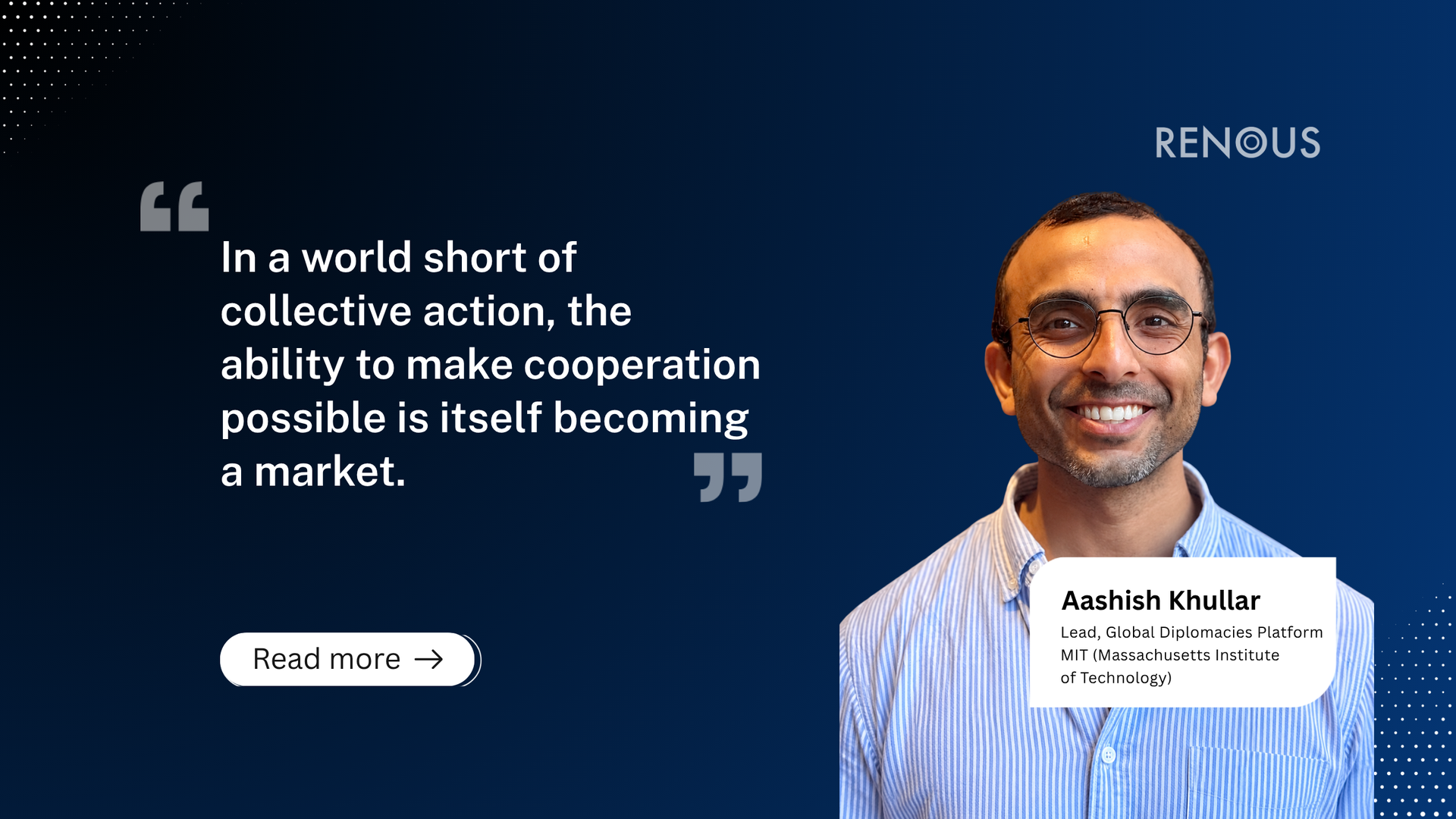
“In a world short of collective action, the ability to make cooperation possible is itself becoming a market.”