 Vantage

Automation, as we know it, is dead—not because RPA, orchestration platforms, chatbots, business applications, analytics tools, or ERPs are irrelevant, but because stitching them together still does not create an AI coworker capable of reasoning, acting, adapting, and completing work end to end.
The next phase of enterprise transformation will not be measured by the number of bots deployed, workflows automated, or dashboards created. It will be measured by outcomes delivered: faster processing, fewer exceptions, stronger controls, better decisions, and greater autonomy.
This shift creates a defining moment for India’s Global Capability Centres. GCCs have evolved from cost-arbitrage and offshore delivery centres into strategic hubs for technology, finance, analytics, engineering, innovation, and enterprise transformation. India’s GCCs are increasingly expected to drive AI-led value creation, not merely execute work designed elsewhere.
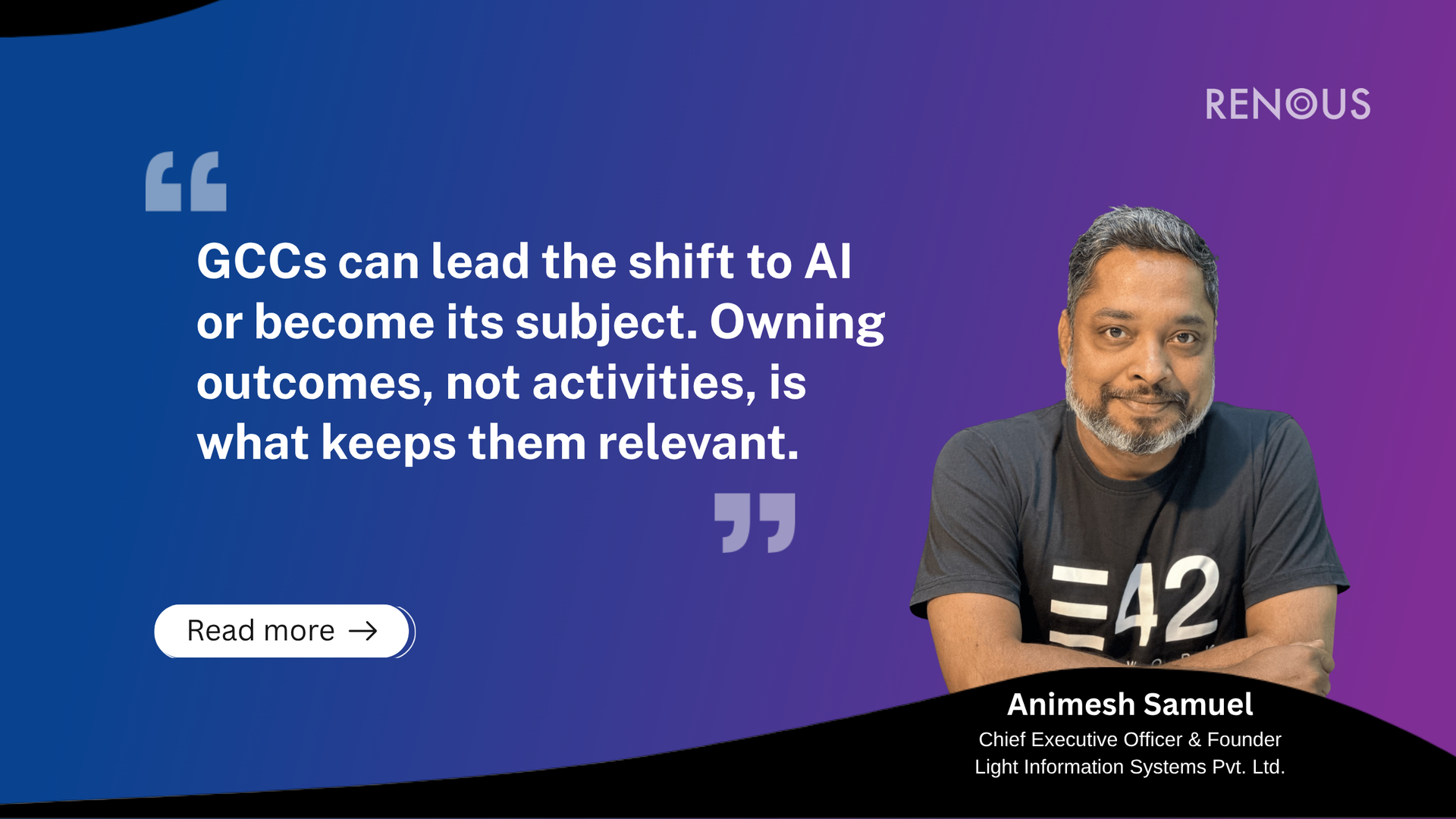
But GCCs now face a clear choice: lead the transformation—or become its subject.
The Existential Risk
AI coworkers are beginning to perform work traditionally delivered by large operational teams. They can understand documents, interpret policies, validate transactions, navigate enterprise systems, manage approvals, resolve standard exceptions, and escalate only what requires human judgment.
When we consider a finance GCC, this changes the question from “How many transactions can we process?” to “How much of this process can operate autonomously, and what outcomes can we guarantee?”
GCCs that continue to measure themselves primarily through headcount, transaction volumes, turnaround times, and the number of subject-matter experts risk becoming strategically replaceable. Their processes may eventually be absorbed into AI-enabled platforms operated elsewhere, while their expertise is encoded into AI workers, policies, and workflows.
This is not an argument that GCCs will disappear overnight. It is a warning that those unwilling to adapt may face an existential risk: losing their relevance, mandate, investment, and ultimately their place in the enterprise operating model.
With a significant share of routine GCC work already exposed to AI-led automation, the urgency is real.
Beyond the SME Metric
Subject-matter expertise remains essential, but it cannot remain the GCC’s defining metric.
For years, “we understand the process better than anyone else” has been a source of authority. GCC teams understand local regulations, business policies, approval structures, ERP configurations, exception patterns, and the operational nuances that are rarely captured in process documents.
That knowledge is precisely why GCCs are best positioned to lead AI transformation. But it must be converted into scalable intelligence.
The future metric cannot be the number of SMEs retained. It must be the outcomes delivered.
An SME who resolves one exception at a time creates value. An AI coworker trained, governed, and continuously improved by that SME can resolve thousands of similar exceptions while preserving business rules, controls, and institutional knowledge. The SME’s role evolves from executing the process to designing, supervising, governing, and improving the intelligence that executes it.
GCCs must move from “we are the experts who perform the work” to “we are the experts who make the enterprise capable of performing the work intelligently.”
Why GCCs Should Lead
India’s GCCs have a compelling case to make to global headquarters. They possess a rare combination of process depth, technology talent, analytics capability, operational experience, and proximity to enterprise systems.
They understand:
- The documented workflow and the actual workflow.
- The policy and the exceptions to the policy.
- The ERP configuration and the manual workarounds around it.
- The transaction and the business context behind it.
- The control requirement and the operational friction it creates.
- The local nuance and its impact on global standardization.
That knowledge is indispensable when building AI coworkers that must operate reliably in complex enterprise environments.
GCCs should therefore insist—with evidence—that they are best positioned to lead this transformation. They must demonstrate measurable improvements in straight-through processing, exception resolution, compliance, cycle time, cost per transaction, audit readiness, supplier experience, and management visibility.
A successful pilot is not enough. The objective must be production-grade, enterprise-scale transformation.
Stop Playing Second Fiddle
Many GCCs still operate as execution partners. Headquarters defines the strategy, selects the platforms, and owns the transformation agenda, while the GCC implements or supports the decision.
That model is no longer sufficient.
GCCs must stop playing second fiddle and take responsibility for the entire transaction lifecycle.
Let’s take an example of a GCC in Accounts Payable. This means owning the journey from invoice receipt through validation, matching, approval, posting, payment readiness, exception handling, auditability, and performance insight.
It means being accountable not merely for processing invoices, but for ensuring that the process is accurate, compliant, timely, intelligent, and continuously improving.
An AI coworker in Accounts Payable illustrates this shift. It can ingest invoices, understand context, validate compliance, manage approvals, handle exceptions, synchronize with the ERP, and drive straight-through processing.
The opportunity for a GCC is not simply to deploy an AI coworker as another automation tool. It is to use it as the foundation for a new operating model—one where humans supervise intelligence, AI workers execute processes, and the GCC owns the outcome.
Beyond Flawless Transactions
Flawless transactions and complete compliance are the baseline—not the destination.
An intelligent GCC must also ask what transactions reveal about the enterprise. Are suppliers repeatedly submitting non-compliant invoices? Are approval bottlenecks delaying payments? Are purchase orders being bypassed? Are payment terms being used effectively? Are certain business units creating disproportionate exceptions? Are fraud risks, leakage, or control failures emerging?
Every transaction contains signals about supplier behavior, operational discipline, policy effectiveness, liquidity, risk, and business performance. An AI-enabled finance function can convert those signals into recommendations and actions—not merely reports.
This is where enterprise intelligence begins.
The New GCC Mandate
Enterprises of the future will be powered by a workforce of AI coworkers—each embedded in a function, governed by policy, connected to enterprise systems, and accountable for outcomes.
The role of the GCC is to build, operate, govern, and continuously improve that workforce.
This requires GCCs to:
- Own outcomes, not just activities.
- Measure autonomy and business impact, not just headcount and volumes.
- Convert process expertise into scalable AI capability.
- Make evidence-based transformation recommendations to headquarters.
- Take accountability for every transaction and exception.
- Use AI to generate insight, not merely reduce manual effort.
- Establish governance that enables AI to act safely and effectively.
The GCC that embraces this mandate can become the enterprise’s transformation engine—moving from service delivery to strategic ownership and from cost arbitrage to intelligence creation.
We see this as a wedge into that future: a practical example of how an AI coworker can transform Accounts Payable into an intelligent, end-to-end operation. The choice for India’s GCCs is clear: they can wait for AI to transform them, or use their unmatched understanding of the enterprise to transform it first.